Classroom · Performance
Weight & Balance, Done Right: Arms, Moments & the CG Envelope
Weight and balance is not paperwork you do to satisfy a checkride — it is a pair of hard limits that decide whether the airplane will climb, rotate, flare, and recover. This lesson builds the whole subject from four words — datum, arm, moment, CG — then walks a complete five-line loading problem, plots it on the CG envelope, shows how burning fuel quietly slides the center of gravity in flight, and explains exactly what a too-forward or too-aft CG does to the airplane — with an original diagram for every idea.
Why it’s a limit, not a suggestion
Every flight must satisfy two independent limits at the same time. First, total weight must be at or under the maximum gross weight. Second, the center of gravity (CG) — the single point where the airplane’s whole weight effectively balances — must fall between the manufacturer’s published forward and aft limits. Pass one and fail the other and the airplane is still not legal to fly. Both boxes have to be checked, every time you load differently.
These are not conservative suggestions padded with margin for you to nibble into. When you fly over gross weight, the airplane simply will not deliver the takeoff distance, climb rate, service ceiling, or stopping performance printed in the POH — those charts were flight-tested at or below the certified weight, so above it every number is optimistic and the structure carries less reserve against gusts and hard landings.
An out-of-limits CG is more insidious because the airplane may feel fine on the ramp. A CG that is too far forward loads the tail heavily, raises the stall speed, and can leave you without enough elevator authority to rotate on takeoff or flare for landing. A CG that is too far aft erodes longitudinal stability — the airplane becomes twitchy in pitch, the stall breaks more sharply, and a spin can become difficult or impossible to recover from. The tail is what keeps a conventional airplane pointing where it’s going; move the balance point behind what the tail can control and you have removed the airplane’s natural tendency to fly straight.
Key idea Two limits, both mandatory: weight ≤ max gross AND CG between the forward and aft limits. Overweight steals performance; a bad CG steals controllability and stability.
Four words: datum, arm, moment, CG
The entire subject is built from four terms. Learn them precisely and the arithmetic becomes obvious — it is nothing more than a lever balancing about a reference line.
The datum is arbitrary but fixed: the manufacturer might place it at the firewall, the tip of the spinner, or the leading edge of the wing. It does not matter where it is, only that every arm in the POH is measured from that same line, so all the numbers are consistent. Arms are usually positive going aft; a station ahead of the datum (occasionally the case) carries a negative arm.
The arm is the lever length. The moment is the twist that lever produces — the same weight far aft produces a larger moment than close to the datum, exactly like a longer wrench turns a bolt more easily. That is why baggage in an aft compartment, though light, can shove the CG backward: it sits on a long arm.
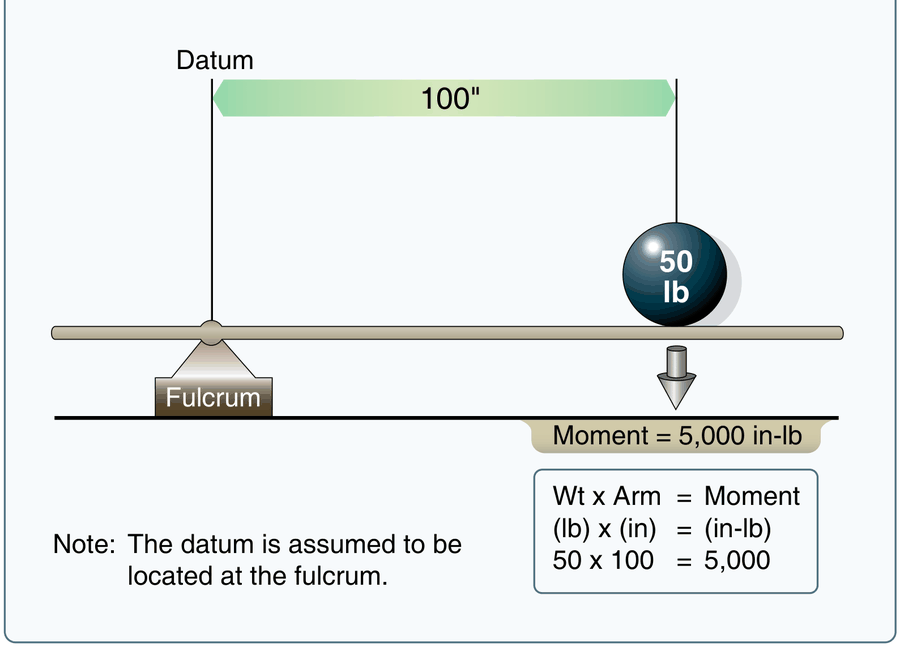
Finally, the CG is where all those competing moments net out. Add up every moment, add up every pound, divide one by the other, and you get a single arm — the balance point of the loaded airplane. That number is what you compare against the envelope.
The method, as a checklist
Every weight-and-balance problem — for any airplane — is the same five-step routine. Once you’ve run it a few times it becomes a table you fill in.
| Step | Do this | Why |
|---|---|---|
| 1 | List every item: empty aircraft, pilot, passengers, fuel, baggage. | Nothing aboard is allowed to be missing from the tally. |
| 2 | Write each item’s weight and its arm (from the POH). | Arm places the weight relative to the datum. |
| 3 | Compute each moment = weight × arm. | Turns each load into its turning effect. |
| 4 | Sum the weights (≤ max gross?) and sum the moments. | First limit check + numerator for the CG. |
| 5 | CG = ΣM ÷ ΣW; confirm it’s between the fwd & aft limits. | Second limit check. |
Two subtleties save people from the classic errors. First, fuel is a weight like any other — convert gallons to pounds before you use it (avgas is about 6.0 lb per gallon). Second, you must run the check for both takeoff and landing, because fuel burns off during the flight and the CG shifts as it goes (more on that below). A load that is legal at engine start can drift outside the envelope by the time you arrive.
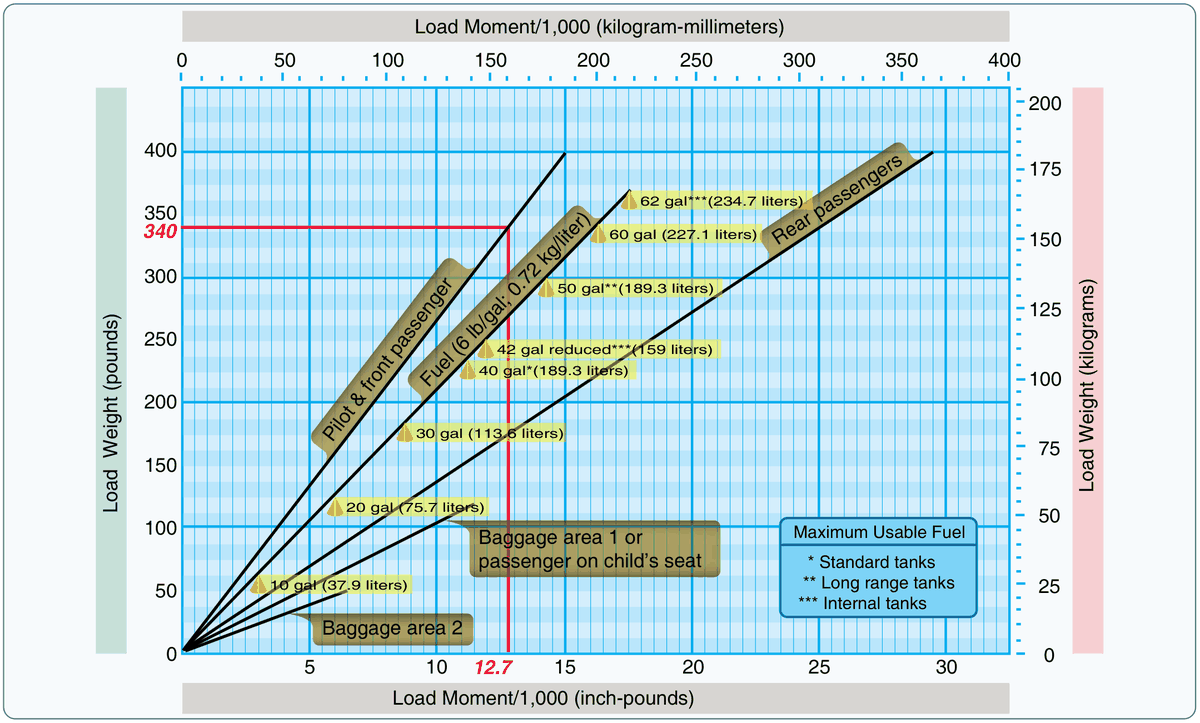
Units Weight in pounds, arm in inches, so moment comes out in inch-pounds (in-lb). Many POHs print a “moment index” (moment ÷ 1,000) to keep the numbers small — same idea, just scaled. Keep your units consistent and the arithmetic can’t betray you.
Where the real numbers come from
This is the step students most often shortcut — and it matters. The weights and arms you plug in are not generic textbook figures. They come from two aircraft-specific sources:
Section 6 of the Pilot’s Operating Handbook (or AFM) gives the station arms — the fixed distances from the datum to the front seats, rear seats, baggage areas, and fuel tanks — along with the loading graphs and the CG-moment envelope for that model. But the empty weight and empty-weight CG are unique to your particular tail number: they come from that airplane’s latest weighing record in the equipment list, updated whenever avionics or equipment change. Two airplanes off the same production line can differ by dozens of pounds and a fraction of an inch. Always start from this airplane’s current empty weight, not a number you memorized.
The stations themselves are just fixed arms measured aft from the datum. Picture them along the fuselage:
Watch out Do not carry last flight’s numbers forward. If you add a passenger, top the tanks, or throw a flight bag in the back, the whole tally changes — re-run it. And if the airplane was recently re-weighed after an avionics install, its empty weight and empty CG changed too.
A full worked example
Let’s load an illustrative light single and run the checklist end to end. (These arms and weights are for teaching — your airplane’s POH and weighing record are the authority.) We’ll color each line to match the station diagram above: empty, front seats, rear seats, fuel, baggage.
First convert the fuel: 40 gallons × 6.0 lb/gal = 240 lb. Now build the table — weight, arm, and weight × arm for every line, then sum the two outer columns:
| Item | Weight (lb) | Arm (in) | Moment (in-lb) |
|---|---|---|---|
| Empty aircraft | 1,500 | 40.0 | 60,000 |
| Pilot + front pax | 340 | 37 | 12,580 |
| Rear passengers | 170 | 73 | 12,410 |
| Fuel (40 gal) | 240 | 48 | 11,520 |
| Baggage | 30 | 95 | 2,850 |
| Totals | 2,280 | 99,360 |
Now the two limit checks. The total weight is 2,280 lb — compare that against the airplane’s max gross weight; here it’s under it, so the first limit passes. Then divide the summed moment by the summed weight for the CG:
A quick sanity check on the moments makes the structure visible: the empty airframe dominates, and the four payload lines each add a much smaller slice. Seeing the proportions helps you predict which way a change will push the CG.
So the loaded CG is about 43.6 inches aft of datum at 2,280 lb. Two numbers — a weight and a CG — and now they get plotted against the published envelope to see whether they land inside it.
The CG envelope
The CG envelope (or CG-moment envelope) is the POH chart that turns your two numbers into a yes-or-no answer. It plots weight up the vertical axis against CG (or moment) along the horizontal axis, with the forward limit on the left, the aft limit on the right, and the max-gross line across the top. Your loaded point must fall inside the enclosed region. If it does, the airplane is legal to fly as loaded; if it lands on the wrong side of a line, you must re-load until it doesn’t.
One detail catches people out: many envelopes taper inward at the forward limit as weight increases. At higher gross weights the forward CG limit moves aft, narrowing the box, because a heavy and nose-heavy airplane would need more tail-down force than the elevator can supply. So a CG that is fine when light can be illegal when heavy — the envelope, not a single number, is the real limit.
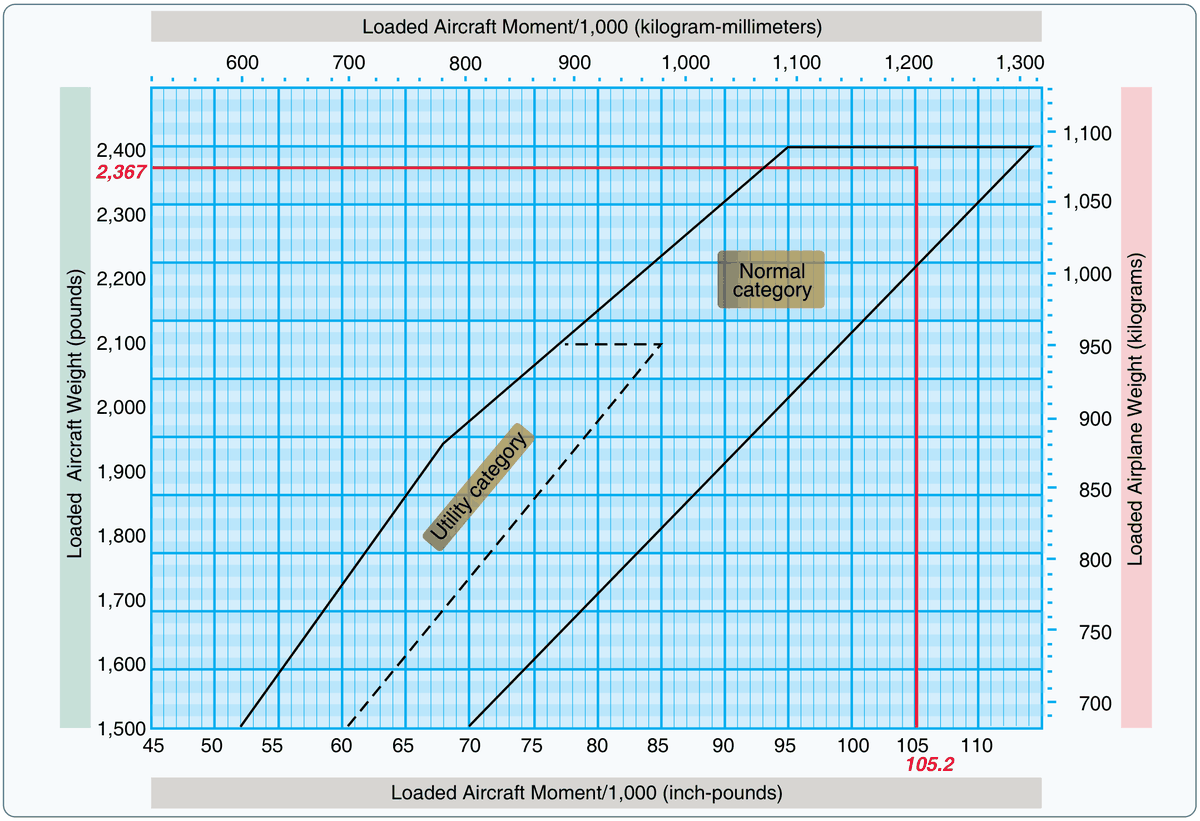
Both ends A legal takeoff is only half the check. Because fuel burns off, the CG moves — so plot the landing point too. The airplane must stay inside the envelope from brake release to touchdown, not just at engine start.
Fuel burn moves the CG
Fuel is heavy, it sits at its own arm, and it disappears during the flight — so the CG is not fixed. Burning fuel is exactly like removing a weight from the fuel station: it changes both the total weight and the total moment, and therefore the CG. Which way the CG moves depends on whether the fuel tanks are ahead of or behind the current CG. Burn fuel that sits aft of the CG and the CG creeps forward; burn fuel forward of the CG and it creeps aft.
Compute the landing CG the same way you did takeoff, just with the burned fuel removed:
Take our example. Suppose we burn 30 gallons (180 lb) of that fuel, which sits at arm 48. Remove 180 × 48 = 8,640 in-lb and 180 lb:
The fuel arm (48 in) is aft of the takeoff CG (43.6 in), so removing it slid the CG forward, from 43.6 to 43.2 in — the short forward drift you saw on the envelope. Here that keeps us safely inside the box, but in an aircraft loaded near a limit the same drift can push a legal takeoff out of bounds by landing. That is precisely why you always check both ends.
What CG position does to the airplane
Two loadings can weigh exactly the same and fly completely differently, purely because of where the CG sits. The CG’s position relative to the wing’s lift and the tail sets the airplane’s stability and control feel. Understanding the trade-off is what makes the limits mean something.
A forward CG
With the balance point forward, the tail must generate more downward force to keep the nose up, which the wing must offset with extra lift — so the effective load, and therefore the stall speed, is higher. The airplane is more longitudinally stable (it strongly resists pitch upsets) but the elevator feels heavy, and near the forward limit you may run short of the pitch authority needed to rotate on takeoff or flare on landing. The added tail-down force also adds drag, trimming a little off cruise performance.
An aft CG
With the balance point aft, the required tail-down force shrinks, so the stall speed is lower, the controls feel light and responsive, and cruise is slightly more efficient. But stability decreases: the airplane is less willing to return to trimmed flight on its own, the stall break is sharper, and beyond the aft limit it can become dynamically unstable — and spin recovery can become difficult or impossible, because the tail no longer has the leverage to force the nose back down. This is the more dangerous direction to err, which is why the aft limit is treated with real respect.
The trade-off in one line Forward CG buys stability at the cost of higher stall speed, heavier controls, and rotation/flare authority. Aft CG buys lighter controls and lower stall speed at the cost of stability — and past the aft limit, at the cost of recoverability. The envelope keeps you in the safe middle. And remember: overweight degrades every performance number regardless of CG.
Common mistakes & misconceptions
These are the errors that turn a correct method into a wrong answer — or a wrong answer into a real hazard. Get ahead of them.
Myth “If I’m under gross weight, I’m fine.” No — weight and CG are two separate limits. You can be well under max gross and still be outside the CG envelope, and that is often the more dangerous failure.
Myth “Check it at takeoff and you’re done.” Fuel burns off and the CG moves. A load that’s legal at engine start can drift out of limits by landing — check both ends.
Myth “Fuel is in gallons.” Moment math needs pounds. Convert first — avgas is about 6.0 lb/gal. Plugging gallons into a moment silently under-counts the fuel by a factor of six.
Myth “Use the book empty weight.” Use this airplane’s empty weight and empty CG from its current weighing record. Equipment changes move both; generic numbers are wrong for your tail number.
Myth “A light bag in the back is harmless.” Baggage rides a long aft arm, so a few pounds there produce an outsized moment — it can push the CG aft faster than you’d expect, and it has its own compartment weight limit too.
Myth “The CG number alone tells me if I’m legal.” A CG is only legal at a given weight. Because the envelope tapers, you must plot the weight-and-CG point on the envelope, not just compare the CG to a single pair of numbers.
Frequently asked questions
What is the datum in weight and balance?
The datum is a fixed reference line chosen by the manufacturer — it might be at the firewall, the spinner, or the wing leading edge. Every arm in the POH is measured from that same line, so its exact location doesn’t matter as long as all measurements are consistent. Arms are normally positive going aft.
What is the difference between arm and moment?
The arm is the horizontal distance in inches from the datum to an item. The moment is that item’s weight multiplied by its arm (in inch-pounds) — the turning effect it produces about the datum. Same weight on a longer arm makes a bigger moment.
How do I calculate the center of gravity?
List every item with its weight and arm, compute each moment (weight × arm), sum all the weights and all the moments, then divide: CG = Σmoment ÷ Σweight. In our example, 99,360 in-lb ÷ 2,280 lb = about 43.6 inches aft of datum. Then confirm both the weight and the CG fall inside the published envelope.
How much does aviation fuel weigh?
Avgas weighs about 6.0 pounds per gallon. So 40 gallons is roughly 240 pounds. Always convert fuel from gallons to pounds before computing its moment.
Why does the CG move as I burn fuel?
Fuel has weight and sits at its own arm, so burning it removes both weight and moment. If the fuel is aft of the current CG, the CG moves forward as it burns; if it’s forward of the CG, the CG moves aft. Compute the landing CG as takeoff moment minus (fuel burned × fuel arm), divided by the reduced weight, and confirm it’s still inside the envelope.
What happens if the CG is too far forward?
A forward CG makes the airplane more stable but raises the stall speed, makes the elevator feel heavy, and adds tail-down force and drag. Near the forward limit you may not have enough pitch authority to rotate on takeoff or flare for landing.
What happens if the CG is too far aft?
An aft CG lowers the stall speed and lightens the controls, but reduces longitudinal stability. Beyond the aft limit the airplane can become unstable in pitch and a spin may be difficult or impossible to recover from — the most dangerous direction to load.
Can I be under max gross weight and still be illegal?
Yes. Weight and balance are two independent limits. You can be comfortably under the maximum gross weight and still have the CG outside the forward or aft limit — which is why you must check both the weight and where the weight-and-CG point lands on the envelope.
What is the CG envelope?
It’s the POH chart that plots weight (vertical) against CG or moment (horizontal), bounded by the forward and aft CG limits and the maximum gross weight. Your loaded point must fall inside the enclosed region. Many envelopes taper inward at the forward limit at higher weights, so a CG that’s legal when light can be illegal when heavy.
Where do the weights and arms come from?
Station arms, loading graphs, and the envelope come from Section 6 (Weight & Balance) of the POH or AFM. The empty weight and empty-weight CG come from that individual aircraft’s current weighing record in its equipment list — not from generic numbers — because they change whenever equipment is added or removed.
Does being overweight affect performance even if the CG is fine?
Yes. Excess weight lengthens the takeoff and landing rolls, reduces climb rate and service ceiling, and cuts your stopping and maneuvering margins — the POH performance charts assume you are at or below the certified weight. A correct CG does not undo the penalty of being over gross.
Ready to load your airplane? Run the real numbers in the weight & balance calculator, carry them into the performance calculator, lock the vocabulary with the flashcards, and explore more lessons in the Classroom.