Classroom · Aerodynamics
How a Wing Actually Flies: Lift, Drag & the Four Forces
Forget the tired “air travels farther over the top so it goes faster” story — it’s wrong, and it never explained how a jet flies inverted. This lesson builds the real picture from the ground up: the four forces that act on every airplane, the two correct and complementary explanations of lift, the equation that ties it all together, why a stall is always about angle of attack and never about airspeed, how drag splits into two competing kinds, and how bank angle multiplies the load on your wings — with an original diagram for every idea and two fully worked examples.
Start with the four forces
Every airplane in flight is pushed and pulled by exactly four aerodynamic forces, and understanding how they balance is the foundation for everything else in this lesson. Lift acts upward, perpendicular to the relative wind. Weight acts downward, toward the center of the earth. Thrust acts forward along the flight path, produced by the propeller or jet. Drag acts rearward, the air’s resistance to the aircraft moving through it. Learn these four and where they point, and the rest of aerodynamics becomes a story about how they trade against each other.
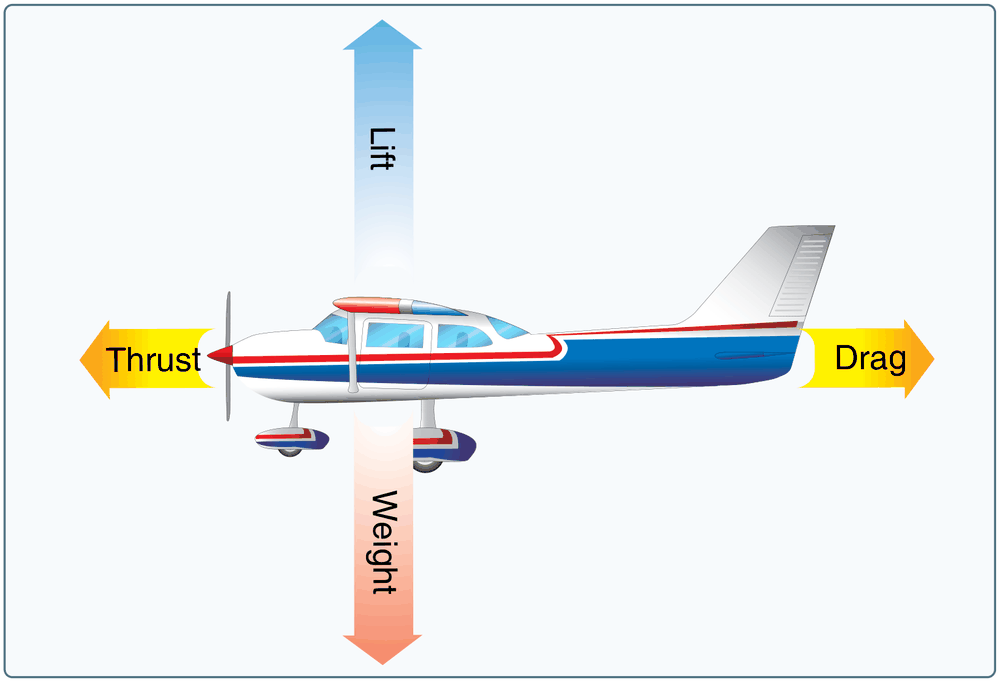
The most important rule about the four forces is what happens when the airplane is neither speeding up, slowing down, climbing, nor descending — a state called unaccelerated, straight-and-level flight. In that condition the forces are in equilibrium: lift exactly equals weight, and thrust exactly equals drag. The airplane isn’t “winning” against gravity; it is precisely matching it. Add power and thrust exceeds drag: hold your airspeed and that excess is converted into a climb, or hold altitude and the airplane accelerates instead. Reduce power and the balance tips the other way.
Key idea In steady straight-and-level flight, lift = weight and thrust = drag. Whenever the airplane accelerates, climbs, descends, or turns, one or more of those pairs is temporarily out of balance — that imbalance is what produces the change in motion.
What actually makes lift (two true stories, one myth)
Lift is the force that makes flight possible, and there are two complementary, equally correct ways to explain it. They are not competing theories — they are two views of the same physics, and a pilot should hold both in mind.
Story 1 — Newton: the wing throws air down
A wing moving through the air deflects a mass of air downward. By Newton’s third law, for every action there is an equal and opposite reaction: if the wing pushes air down, the air pushes the wing up. That upward reaction is lift. This is why lift depends on the wing being at a positive angle to the oncoming air — the more air it turns downward (the “downwash”), the more lift it makes. It’s also why a flat plate, a curved airfoil, or even an inverted airfoil can all fly: any surface set at an angle to the wind deflects air and generates a reaction.
Story 2 — Bernoulli: lower pressure over the top
The same wing also creates a pressure difference. Air accelerating over the curved (cambered) upper surface has lower static pressure than the slower-moving air beneath the wing — a relationship described by Bernoulli’s principle (where flow speeds up, its pressure drops). Higher pressure below and lower pressure above produces a net upward force. Integrate that pressure difference over the whole wing and you get lift again — the very same force, counted a different way.
Bust the myth The old “equal transit time” story — that two air molecules split at the leading edge must meet again at the trailing edge, so the top one goes faster because it has farther to travel — is false. The air over the top actually reaches the trailing edge sooner, and there is no law requiring the molecules to reunite. Camber and angle of attack accelerate the upper flow, but not for that reason. Discard the myth; keep Newton and Bernoulli.
Both stories are true because they describe the same event. The wing turns air downward (Newton), and turning that air requires a pressure field with low pressure above and high pressure below (Bernoulli). You cannot have one without the other. Whether you count the downward momentum given to the air or the pressure integrated over the surface, you arrive at the identical number for lift.
Key idea Lift = the wing deflects air downward (Newton’s 3rd law → upward reaction) and creates lower pressure over the top than underneath (Bernoulli). Two descriptions, one force. The “equal transit time” explanation is a myth.
The lift equation: what you can actually change
All of the qualitative talk above is captured in one compact formula. Every variable in it is something a pilot either controls or must account for, so it’s worth reading slowly:
| Term | Name | What it is / how you affect it |
|---|---|---|
| L | Lift | The force produced, in pounds (or newtons). In level flight it must equal weight. |
| CL | Coefficient of lift | A number set by the airfoil shape and, moment to moment, by the angle of attack. Raise the AOA and CL rises — until the critical angle. Flaps raise it too. |
| ρ | Air density (rho) | Thinner air (hot, high, humid — high density altitude) means less lift for the same speed. This is why performance suffers on a hot day at altitude. |
| V² | Velocity squared | Lift varies with the square of airspeed. Double your speed and, all else equal, you quadruple the lift available. |
| S | Wing area | Total planform area of the wing. Extending flaps effectively increases it on many aircraft. |
The single most important behavior hiding in that equation is the V² term: lift changes with the square of airspeed. This one fact explains an enormous amount of practical flying. It is why, in a steady descent to landing, small speed changes have an outsized effect on how much lift the wing makes; why the wing can support the airplane’s weight at a low angle of attack when fast but needs a high angle of attack when slow; and why stall speed and maneuvering behavior scale the way they do. In level flight, weight is fixed, so if V goes up, CL must come down to keep L equal to weight — you fly at a lower angle of attack when fast and a higher one when slow. Hold that thought; it is the bridge to understanding the stall.
Density altitude connection The ρ (air density) term is exactly why a hot, high, humid day robs you of lift and climb. Turn temperature, altitude, and altimeter into a real density-altitude number, and load your aircraft against it, with the performance calculator and the weight & balance calculator before you fly.
Angle of attack — and why it is not pitch attitude
The term inside the lift equation that a pilot changes second-by-second is the coefficient of lift, and the pilot changes it through angle of attack (AOA). This is the concept students most often get wrong, so let’s pin it down precisely. Angle of attack is the angle between the chord line of the wing and the relative wind. Two definitions you must know cold:
The chord line is the straight line drawn from the leading edge to the trailing edge of the airfoil. The relative wind is the airflow the wing actually meets — it is parallel to and opposite the flight path. If the airplane moves forward and slightly downward, the relative wind comes from ahead and slightly below. AOA is simply the angle between those two lines.
Here is the crucial distinction: angle of attack is not pitch attitude. Pitch attitude is the angle between the airplane’s nose and the horizon — what you see over the glareshield. Angle of attack is the angle between the wing’s chord and the air it’s flying through. They are different things, and they routinely disagree. In a steep power-off descent the nose can be well below the horizon (low pitch attitude) while the wing sits at a high angle of attack. In a nose-high climb the reverse can be true. You can even hold a perfectly level pitch attitude and stall the wing by loading it in a turn. The wing feels the relative wind, and it neither knows nor cares where the horizon is.
Key idea Raising angle of attack raises the coefficient of lift — that’s how you make more lift at a given speed. But AOA is measured against the relative wind, not the horizon. Confusing the two is the root of most stall misconceptions.
The critical angle of attack and the stall
Raise the angle of attack and the coefficient of lift climbs steadily — but only up to a point. At a specific angle, called the critical angle of attack (roughly 16–18° for many light-aircraft airfoils), the smooth airflow can no longer follow the sharply upturned upper surface. It separates from the wing, breaking into turbulent, churning flow. Lift drops sharply and drag rises. That is a stall.
Now the single most important sentence in this entire lesson: a stall is always, and only, the result of exceeding the critical angle of attack. Nothing else defines a stall. Because the wing stalls at one fixed angle regardless of the situation, a stall can happen at any airspeed, any weight, any pitch attitude, and any bank angle. You can stall in a screaming dive if you haul back hard enough to push the wing past its critical angle. You can stall while pointed straight down. The airspeed indicator does not decide when you stall — the angle of attack does.
So why do we talk about a “stall speed” at all? Because in one specific, common condition — wings level, one G, a particular weight — the critical angle of attack corresponds to a particular airspeed, and that speed is a convenient stand-in for the angle. Change the condition (bank into a turn, pull G, load the airplane heavier) and the speed at which you reach the critical angle changes, even though the critical angle never does.
Why stall speed barely changes with altitude Indicated stall speed stays nearly constant with altitude because the airspeed indicator is really a dynamic-pressure gauge (it senses ½ρV²). The wing stalls at a fixed angle of attack, which corresponds to a fixed dynamic pressure — and that fixed dynamic pressure produces nearly the same indicated airspeed no matter how thin the air. Your true airspeed at the stall is higher up high, but the number on the dial reads about the same.
Self-check True or false: “If I keep my airspeed above the published stall speed, I cannot stall.”
Show answer
False. The published stall speed applies only to wings-level, 1 G flight at a given weight. Bank steeply or pull hard and you can exceed the critical angle of attack — and stall — at an airspeed well above the book number. This is exactly how accelerated stalls (and base-to-final stall/spin accidents) happen. The wing stalls at an angle, not a speed.
Drag: the two kinds, and why they fight each other
Lift never comes free — it always drags a bill along with it. Total drag on an airplane is the sum of two very different kinds of drag that behave in opposite ways as speed changes, and understanding their tug-of-war explains best-glide speed, best-endurance speed, and why airplanes have a “sweet spot” airspeed.
Induced drag — the price of making lift
Induced drag is a by-product of producing lift. Where the high-pressure air under the wing meets the low-pressure air above it at the wingtip, air spills around the tip and rolls up into a wingtip vortex. That swirling flow tilts the local lift vector rearward, and the rearward component is induced drag. Because it comes from making lift at a high angle of attack, induced drag is greatest at low airspeed / high AOA — slow flight and the approach to a stall — and it decreases as you speed up and lower the AOA.
Parasite drag — the price of moving through air
Parasite drag is everything that resists the airplane simply shoving through the air, and it has three parts: form drag (the shape pushing air aside), skin-friction drag (air rubbing along the surface), and interference drag (turbulence where components like the wing and fuselage join). Parasite drag rises with the square of airspeed — go faster and it climbs steeply. It is small when slow and dominant when fast, the mirror image of induced drag.
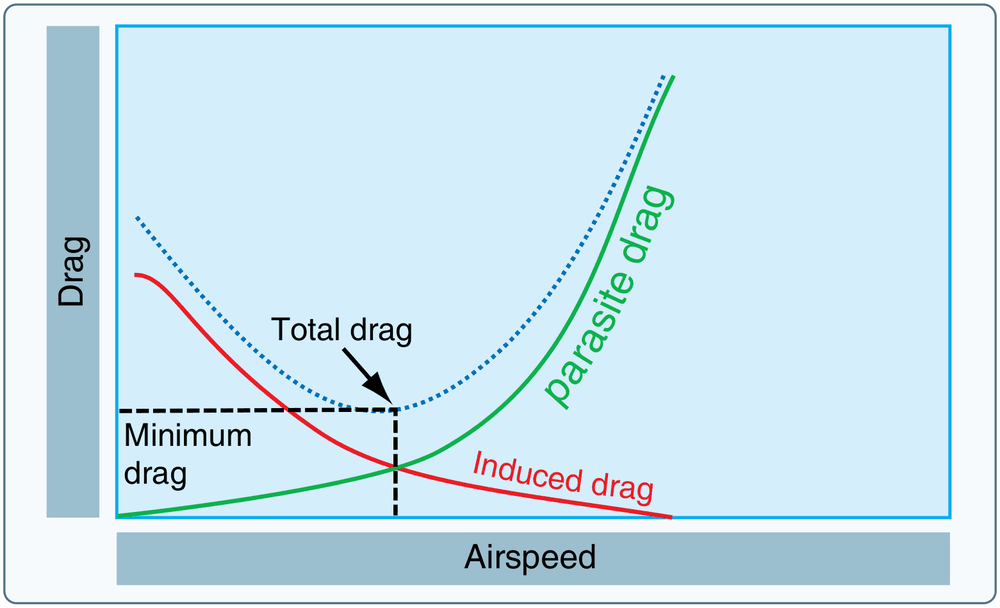
Add the two curves and you get the total drag curve, a U-shape. Its lowest point — the airspeed of minimum total drag — is where induced and parasite drag are equal, and it corresponds to the aircraft’s best lift-to-drag ratio (L/D max). That airspeed (really that angle of attack) is the most aerodynamically efficient the airplane can be: it is your best-glide speed after an engine failure, giving the most distance per foot of altitude, and it’s the basis for best-range and best-endurance planning. Fly faster and parasite drag punishes you; fly slower and induced drag does.
Key idea Total drag = induced drag + parasite drag. Induced drag rules at low speed (high AOA); parasite drag rules at high speed. The bottom of the U — L/D max — is your best-glide, most-efficient angle of attack.
Why a single-engine airplane pulls left
A propeller-driven airplane doesn’t fly perfectly straight on its own — especially at low speed and high power, such as on the takeoff roll and initial climb, it tends to yaw and roll to the left. This isn’t one effect but four, and they stack up most strongly exactly when you have the least airspeed and the most power. Right rudder on takeoff is the pilot’s answer to all four.
| Effect | Cause | When it’s strongest |
|---|---|---|
| Torque reaction | Newton’s 3rd law: the engine spins the prop one way, so the airframe is pushed to roll the opposite way (left). | High power, low airspeed. |
| Spiraling slipstream | The prop wash corkscrews back around the fuselage and strikes the vertical tail on its left side, yawing the nose left. | High power, low speed (climb). |
| P-factor | At high AOA the descending blade (on the right) meets the air at a greater angle and produces more thrust than the ascending blade, yawing left. | High AOA + high power (climb, slow flight). |
| Gyroscopic precession | The spinning prop acts like a gyro; a pitch change applies a force felt 90° later in the direction of rotation (classic in tailwheel takeoffs raising the tail). | During pitch changes. |
All four share a theme: they intensify at high power and high angle of attack — precisely the takeoff and climb regime. That is why the takeoff briefing includes “right rudder,” and why holding the centerline on the roll takes active feet, not a fixed rudder position.
Load factor: how bank angle multiplies your weight
When you bank into a turn, the wing has two jobs at once: hold the airplane up and pull it around the turn. To do both it must generate more total lift than the airplane weighs, and the ratio of that lift to the aircraft’s weight is the load factor, measured in G:
In a level turn, the required load factor depends only on bank angle (θ), not on the airplane, its weight, or its speed. Tip into 30° and the wings carry 1.15 times the weight; 45° brings 1.41 G; a 60° level turn doubles it to a full 2.0 G — the airplane and everyone in it now weigh twice as much as they do sitting on the ramp.
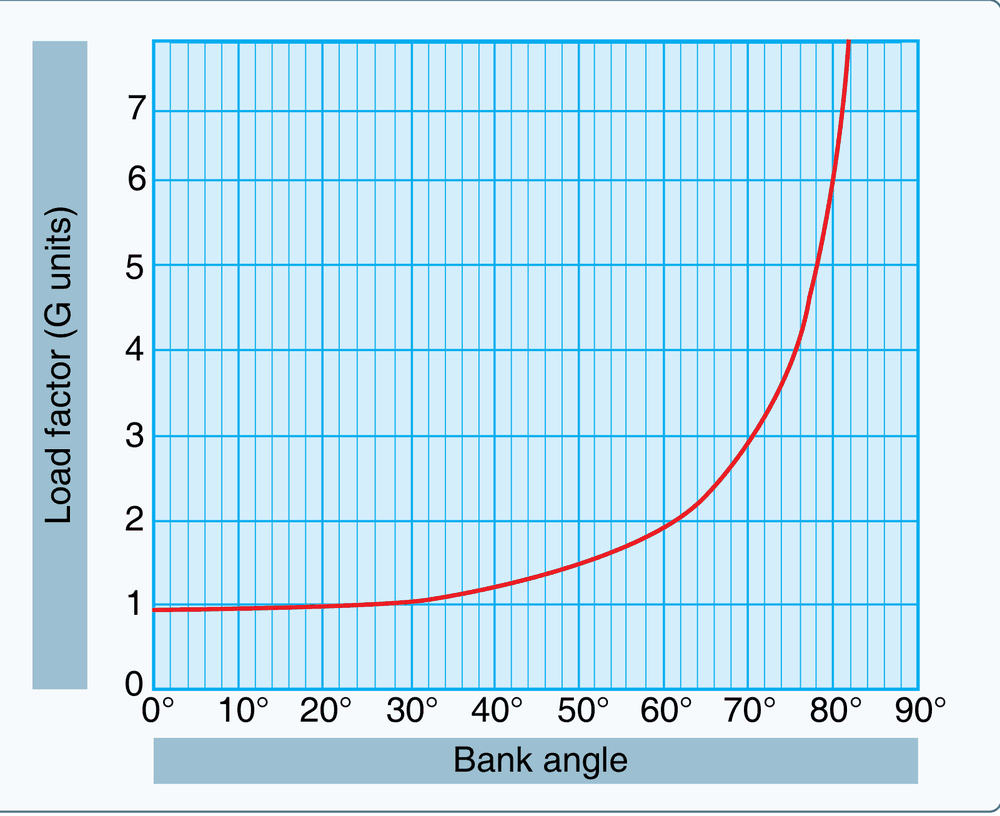
Load factor has a direct, dangerous consequence for stalls. Because the wing must make more lift, it flies at a higher angle of attack for a given speed — so it reaches the critical angle at a higher airspeed. The relationship is precise: new stall speed = normal stall speed × √n. Since √2 = 1.41, a 60° level turn raises your stall speed by about 41%. A trainer that stalls at 50 knots wings-level will stall near 71 knots in a 60° bank — which is exactly why an over-banked, over-pulled turn from base to final is so treacherously easy to stall.
| Bank angle | Load factor n = 1/cos θ | Stall speed multiplier √n | Vs 50 kt becomes |
|---|---|---|---|
| 0° | 1.00 G | ×1.00 | 50 kt |
| 30° | 1.15 G | ×1.07 | ~54 kt |
| 45° | 1.41 G | ×1.19 | ~60 kt |
| 60° | 2.00 G | ×1.41 | ~71 kt |
Va and weight Maneuvering speed (Va) — the fastest speed at which a full, abrupt control input won’t overstress the airframe — decreases as weight decreases. A lighter airplane reaches its limit load factor at a lower speed because it accelerates (stalls-away the excess G) more readily, so a lightly loaded airplane must slow down more in turbulence. Check how weight shifts your numbers with the weight & balance calculator, which also covers CG and load-factor effects.
The three axes and three kinds of stability
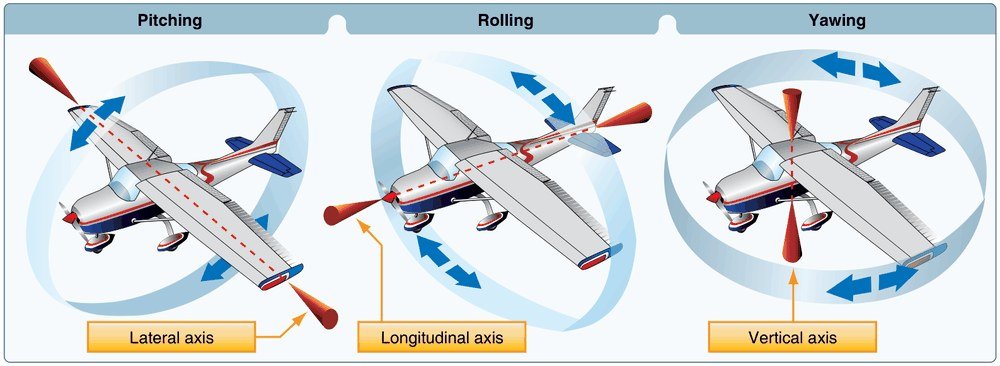
An airplane rotates about three imaginary axes that all pass through its center of gravity (CG). Each axis has a motion, a control surface, and a kind of stability — the aircraft’s built-in tendency to return to its original attitude after a disturbance.
| Stability | Axis | Motion | What provides it |
|---|---|---|---|
| Longitudinal | Lateral (wingtip–wingtip) | Pitch | Elevator, horizontal stabilizer, and CG position — the most important for handling. |
| Lateral | Longitudinal (nose–tail) | Roll | Wing dihedral (the upward V of the wings). |
| Directional | Vertical (through CG) | Yaw | The vertical fin (like a weathervane). |
Notice the naming can trip you up: longitudinal stability is stability in pitch, about the lateral axis — it’s named for the long axis it keeps steady, not the axis it rotates about. It is the most critical of the three, and it is governed largely by where the CG sits.
How CG position changes everything
The center of gravity is the balance point, and moving it forward or aft trades stability against control:
Forward CG
More stable, but a higher stall speed (more tail-down force is needed, so the wing carries more), heavier controls, and more tail-down force means more trim drag.
Aft CG
Less stable, a lower stall speed and lighter controls, but harder spin recovery — and if far enough aft, dangerous instability.
A forward CG requires the tail to push down harder to keep the nose up; that download adds to the load the wing must carry, so the wing reaches its critical angle at a slightly higher speed — a higher stall speed — and the controls feel heavier and more positive. An aft CG relieves that tail download, lowering stall speed and lightening the controls, but it erodes the natural nose-down recovery tendency, making stalls and spins harder to recover. Every airplane has a CG envelope you must stay inside; confirm yours with the weight & balance calculator before each flight.
Ground effect and wake turbulence
Ground effect — a temporary efficiency boost near the surface
When the wing comes within about one wingspan of the surface, the ground interferes with the formation of wingtip vortices and downwash. With the vortices suppressed, induced drag drops significantly. The wing suddenly becomes more efficient, and this has two very practical consequences. On takeoff, an airplane can lift off below its normal flying speed while in ground effect — and then settle back or struggle to climb once it rises out of it, where induced drag returns. On landing, the same reduced drag makes the airplane want to float down the runway if you carry any excess speed.
Wingtip vortices and wake turbulence
Those same wingtip vortices are the source of wake turbulence — the invisible, powerful rotating air trailing behind every wing that is making lift. The vortices are strongest when an aircraft is heavy, clean (flaps and gear up), and slow, because that combination demands the highest angle of attack and the biggest pressure difference at the tips. A large jet on departure — heavy, clean, slow — is the classic wake-turbulence hazard, and the memory aid is exactly those three words: heavy, clean, slow. Because the vortices sink and drift, the safe technique is to stay at or above a preceding heavy aircraft’s flight path and land beyond its touchdown point.
Two sides of one coin The wingtip vortex is the villain of induced drag and wake turbulence and the reason ground effect works. Suppress the vortex (fly near the ground) and induced drag falls; strengthen it (heavy, clean, slow) and both induced drag and the wake behind you grow.
The region of reversed command: “behind the power curve”
The total drag curve hides one more counterintuitive lesson. On the fast side of L/D max (the region of normal command), flying is intuitive: to go slower you reduce power, to go faster you add it. But on the slow side of that curve — at low airspeed and high angle of attack — induced drag climbs so steeply that the relationship flips. Here, in the region of reversed command, you need more power to fly slower, because holding altitude at a lower speed demands overcoming rapidly rising induced drag.
This is what pilots mean by being “behind the power curve.” On a slow, dragged-in final approach, adding power — not pitching down — is often what arrests a sink, and getting slow and high on the drag curve can leave you unable to climb even at full throttle. It is an especially important trap during short-field and slow-flight operations, where the airplane is deliberately flown at a high angle of attack near the back of the curve.
Tie it together Left of L/D max you’re behind the power curve: high AOA, high induced drag, and more power needed to fly slower. It’s the same physics as induced drag and the approaching stall — all consequences of flying the wing at a high angle of attack.
Two worked examples
Numbers make the concepts concrete. Here are two calculations you can reproduce, using the exact relationships from this lesson.
Example 1 — How much does a 45° level turn raise your stall speed?
Your trainer stalls at 50 KIAS wings-level (1 G) at gross weight. You roll into a 45° level turn. First find the load factor, then apply the √n rule.
So the wing that stalled at 50 knots now stalls at about 60 knots in the 45° bank — a 10-knot jump. Steepen to 60° (2.0 G, √2 = 1.41) and it climbs to about 71 knots. This is why a hurried, steepening base-to-final turn is so dangerous: your stall speed is chasing your airspeed upward just as you slow down.
Example 2 — What does the V² term mean for lift?
An airplane in level flight is trimmed at 100 knots. Its wing is producing exactly enough lift to equal its weight. What happens to the available lift, at the same angle of attack, if airspeed increases to 140 knots? Use L ∝ V² (holding CL, ρ, and S constant).
Raising speed from 100 to 140 knots — only a 40% increase — would produce nearly double (1.96×) the lift at the same angle of attack. Of course, in steady level flight lift must still equal weight, so the pilot (or trim) reduces the angle of attack as speed builds, lowering CL to keep total lift constant. That trade — more speed, lower AOA — is the everyday expression of the V² term, and it’s why fast flight uses a low angle of attack and slow flight a high one.
Common mistakes & misconceptions
These are the errors that trip up almost every student pilot — and a few certificated ones. Get ahead of them.
Myth “Air over the top travels farther, so it must go faster — that’s what makes lift.” This equal transit time story is false. Lift comes from the wing deflecting air downward (Newton) and the accompanying low pressure over the top (Bernoulli) — not from any rule that split air molecules must reunite at the trailing edge.
Myth “A stall happens when you fly too slow.” A stall happens when the wing exceeds its critical angle of attack — which can occur at any airspeed, including fast, if you pull hard enough. Speed is only a proxy in wings-level, 1 G flight.
Myth “Angle of attack is the same as pitch attitude.” No. AOA is measured against the relative wind, not the horizon. You can have a low nose and a high AOA (steep power-off descent) or a high nose and a low AOA.
Myth “Bank angle doesn’t affect stall speed.” It does, strongly. Stall speed rises with √n; a 60° level turn (2 G) raises it about 41%.
Myth “Maneuvering speed is higher when the airplane is light.” The opposite: Va decreases as weight decreases. Slow down more in turbulence when lightly loaded.
Myth “To fly slower on final, just pull the nose up.” On the back of the power curve (region of reversed command) you need more power to fly slower. Pitch controls angle of attack; power controls whether you can hold altitude there.
Frequently asked questions
What are the four forces of flight?
Lift (acting upward, perpendicular to the relative wind), weight (downward, toward the earth), thrust (forward, from the engine/propeller), and drag (rearward, the air’s resistance). In steady, unaccelerated straight-and-level flight, lift equals weight and thrust equals drag.
What actually creates lift — Newton or Bernoulli?
Both, because they describe the same force two ways. The wing deflects air downward, and by Newton’s third law the air pushes the wing up. Simultaneously, faster flow over the curved upper surface has lower pressure than the air below (Bernoulli), producing an upward force. Turning the air and the pressure field are inseparable. The old “equal transit time” explanation is a myth.
What is the lift equation?
L = CL × ½ρV² × S. Lift equals the coefficient of lift (set by airfoil shape and angle of attack) times one-half the air density (ρ) times velocity squared, times wing area (S). The key takeaway is that lift varies with the square of airspeed.
What is the difference between angle of attack and pitch attitude?
Angle of attack is the angle between the wing’s chord line and the relative wind (the airflow the wing meets). Pitch attitude is the angle between the airplane’s nose and the horizon. They are independent: you can hold a low pitch attitude at a high angle of attack, and vice versa. The wing stalls based on angle of attack, not pitch.
Can an airplane stall at any airspeed?
Yes. A stall is always caused by exceeding the critical angle of attack (about 16–18° for many airfoils), and that can happen at any airspeed, weight, or attitude. Published stall speed applies only to wings-level, 1 G flight; loading the wing in a turn or an abrupt pull can stall it at a much higher speed.
Why does stall speed stay about the same at altitude?
Because the airspeed indicator measures dynamic pressure (½ρV²), and the wing stalls at a fixed angle of attack that corresponds to a fixed dynamic pressure. That fixed dynamic pressure yields nearly the same indicated airspeed regardless of altitude — even though your true airspeed at the stall is higher up high.
What is the difference between induced and parasite drag?
Induced drag is a by-product of making lift — it comes from wingtip vortices and is greatest at low speed and high angle of attack. Parasite drag (form, skin-friction, and interference drag) is the resistance of pushing through the air and rises with the square of airspeed. Their sum is total drag, and its minimum is L/D max — your best-glide, most efficient angle of attack.
Why does a single-engine airplane turn left on takeoff?
Four left-turning tendencies stack up at high power and high angle of attack: torque reaction (the airframe rolls opposite the prop), spiraling slipstream (prop wash strikes the tail left of center), P-factor (the descending blade makes more thrust at high AOA), and gyroscopic precession (felt during pitch changes). Right rudder counters them.
How much does a steep turn increase load factor and stall speed?
In a level turn, load factor n = 1/cos(bank): 30° ≈ 1.15 G, 45° ≈ 1.41 G, and 60° = 2.0 G. Stall speed rises with the square root of load factor (Vs‑new = Vs × √n), so a 60° bank raises stall speed about 41% (×1.41).
What is ground effect?
Within roughly one wingspan of the surface, the ground disrupts the wingtip vortices and downwash, which reduces induced drag. The wing becomes temporarily more efficient, so an airplane can lift off below normal flying speed or float on landing if it carries excess speed.
When are wingtip vortices (wake turbulence) strongest?
When the generating aircraft is heavy, clean (flaps/gear up), and slow — the combination that demands the highest angle of attack and largest tip pressure difference. Stay at or above a preceding heavy aircraft’s flight path and land beyond its touchdown point.
How does center of gravity affect stability and stall speed?
A forward CG makes the airplane more stable but raises stall speed (more tail-down force means the wing carries more load), makes controls heavier, and adds trim drag. An aft CG lowers stall speed and lightens controls but reduces stability and makes spin recovery harder. Always load within the CG envelope — check it with the weight & balance calculator.
What is the region of reversed command?
It’s the slow, high-angle-of-attack side of the total drag curve (below L/D max), where induced drag rises so steeply that you need more power to fly slower in level flight. Pilots call it being “behind the power curve,” and it matters most on slow approaches and short-field work.
Ready to go deeper? Lock in these fundamentals with the aerodynamics flashcards, explore how loading changes the numbers in the weight & balance calculator, run real figures through the performance calculator, and browse the rest of the free course in the Classroom.